Advertisement 300 X 250

Girls' Best Friend

Bright and sparkly. Gemstones came to my mind when I was removing this Dragon Fruit and Orange jelly from the mould. Like a combination of gemstones...rubies, amber and diamonds, all in one!

Dragon's Eyes

The literal translation for the name of a small brown, juicy exotic fruit from the lands of Asia, known as Longan in Chinese, packed into these muffins

Nostalgia

A taste from the humble beginnings, the Long Bean Rice brings back beautiful memories of the yesteryears

Light and Fluffy

Lemon, Yogurt and Cranberries~a nice blend of flavours in a light and fluffy chiffon cake

Bread Stories

Asian style buns ~ Popular as breakfast food or snack, sweet/savoury fillings wrapped in soft, cottony bread

Showing posts with label Pork. Show all posts

Monday, 28 July 2014

Ribs, The Pinoy Way

Hello there my blogging friends, it has been awhile, my apologies for not visiting.  I hope to catch up soon.   Life has been busy after going back to full time employment.  Hats off to my friends who are working full time yet find time to blog constantly and beautifully while i am struggle to find a right rhythm!

Asian Food Fest blogging event moves on to the Philippines this month and I am quite glad that i managed to complete my 'homework' early but yet i am rushing to post this unfortunately  :(

Don't know much about Pinoy cuisine and have not had much opportunity to savour them except those had during a brief trip to the beautiful Cebu island a few years back.

The only Pinoy dish that i can claim i know how to make would be the Adobo which they say is the unofficial national dish.  I learned how to make this a few years back and i make it occasionally ever since.  It's easy to make (no. 1 criteria to make it into my house menu)  and it's delicious, can't be better...

Adobo is a simple stew like meat dish made by braising the meat in essentially soy sauce, vinegar and garlic. One can make it with chicken, pork or even seafood (i read) but i chose pork of course since i wanted to add this into my collection of Asian Pork Ribs dish :)  Apart from the variation in the choice of meat, other extras like potatoes and eggs can be added into the dish too.  I tried with potatoes since they can never go wrong in stews.

The meat is tender with a unique mix of savoury, sweet and tangy flavors.  Flavors are more intense if left to marinade longer (i left it overnight and made it for lunch).  I like mine with a little sweetnes hence the addition of  a little brown sugar.  A comforting dish that goes well with rice.

Recipe
Source: Pansalang Pinoy

Ingredients
  • 2 lbs pork belly (850g) 
  • 2 tbsp garlic, minced or crushed (4 tbsp)
  • 5 pieces dried bay leaves (3 pieces)
  • 4 tbsp vinegar
  • 1/2 cup soy sauce (1/3 cup)
  • 1 tbsp whole pepper corn
  • 1 cup water
  • 1 tsp brown sugar
  • 2 russet potatoes skinned and cut into quarters
  • salt to taste
Method
  1. Combine the pork belly, soy sauce, and garlic then marinade for at least 1 hour (I left it the fridge overnight and made it for lunch the next day)
  2. Heat a heavy based pot and put-in the marinated pork belly to brown the meat.
  3. Add water, whole pepper corn, and dried bay leaves then bring to a boil. 
  4. Simmer for 20 minutes.  
  5. Add in vinegar and simmer for another 10 minutes or until meat is tender.
  6. Add in potatoes and simmer for another 15 minutes or until potatoes is soft.
  7. Add sugar and salt to taste.
Notes: My variation in blue


I am submitting this post to Asian Food Fest – Philippines hosted by The Sweet Spot.

Photobucket

This post is linked to the event Little Thumbs Up (July 2014 Event: Potato) - organised by Zoe (Bake for Happy Kids) and Mui Mui (My Little Favourite DIY) and hosted by Jasline (Foodie Baker

Friday, 27 June 2014

Ribs the Vietnamese Way

Yes, that's pork ribs you are staring at in case you can't make out what it is!  Unfortunately that is the best photo that i can find for this dish even after changing plates, with garnish, without garnish, this angle, that angle etc, etc, etc and yet this is what i got.  I am sure fellow bloggers can relate to this.  Must have been my bad photo day.  Sometimes it's just so hard to get one nice photo.  I was contemplating whether to post it.   The good thing is it tasted delicious, it's just the photo that isn't doing it justice.  So, since i did do my homework, I will add it to my Asian Pork Ribs collection (if you have been following me on this) for good or for bad :)

This is really another simple recipe to add to the other 2  equally simple Vietnamese recipes (not that all Vietnamese dishes are simple, difficult ones are just not within my territory).  I think grilling is the more popular method with ribs but i am not doing the grill in this hot weather.  This recipe requires the meat to be marinated then pan fried for awhile before adding in water to braised the dish for the meat to be tender.

The addition of lemon grass and ginger made it really fragrant, good enough to  pique hubs' interest to  ask what was for dinner.

Recipe
Adapted from: Wandering Chopsticks

Ingredients
  • 800g pork ribs
  • 2 stalks lemongrass, finely minced
  • 6 cloves garlic, finely minced
  • 1-inch knob ginger, finely minced
  • 1 chili pepper, finely minced (omitted)
  • 2 tbsp honey
  • 2 tbsp Nuoc Mam (Vietnamese Fish Sauce)
  • 1 tbsp rice wine vinegar
  • 1 tsp salt  
  • 1 tsp ground black pepper
  • 1 cup water 
Steps
  1. Combine lemongrass, garlic, ginger and chili pepper and finely mince everything in a food processor until a rough paste is formed.
  2. Add honey, fish sauce, rice wine vinegar, salt and ground black pepper to the paste. Then slather the marinade all over the pork ribs.  
  3. Leave the ribs in the fridge to season for 1-2 hours.
  4. In a large sauce pan on high heat, drizzle a bit of oil and quickly sear the ribs. Add 1 cup of water, cover the pan, turn the heat down to medium-low, and let simmer for about 30 to 45 minutes.
  5. Check from time to time and make sure nothing's burning, stirring occasionally and make taste adjustments or add water if necessary. The marinade will gradually thicken into a rich sauce.
Notes:
  1. The original recipes calls for pork chops which i substituted with pork ribs.
  2. I reduced the amount of water from 2 cups to 1 cup and adding about another 1/4 cup when the gravy starts to thicken.
  3. I used Thai fish sauce instead since it was on hand.

"I am submitting this post to Asian Food Fest - Indochina hosted by Kelly Siew Cooks."


Wednesday, 11 June 2014

Pork Corn Anyone?

This is another very simple Vietnamese recipe.  After looking at quite a few recipes, i realised that Fish Sauce is a common ingredient in many Vietnamese dishes and it is quite amazing how this sauce brings out the umami flavor.

I decided to give this dish a try because i find this combination of pork and corn quite unique.  The contributor of the recipe mentioned that the inspiration for this dish came from a trend to include sweet corn in steamed rice.  All it takes is to marinade thin meat slices with some salt and pepper then stir fry it with corn kernels and some seasoning.  The contributor also suggested that the dish will go well with prawn crackers but i didn't have any on hand to try out unfortunately.

 
 A sweet and savory combination that went well with rice.  

Recipe-Fried Pork Belly with Sweet Corn Recipe (Thịt Ba Chỉ Xào Bắp)
Source: Vietnamese Food

Ingredients
  • 1 – 2 sweet corns (1 cup corn kernels)
  • 200g pork belly (160g pork belly)
  • Fish sauce,  (2 tbsp)
  • Spring onion (omitted)
  • Purple onion (3 shallots, sliced thinly)
  • Maggie Seasoning Powder (omitted) 
  • Onion (omitted)
  • Chili powder (omitted)
  • Salt 
Steps
  1. Remove kernels from corn cob or use readily available kernels.
  2. Clean pork belly, slice thinly then marinade with ½ teaspoon salt and a some freshly ground black pepper.  Set aside for 15 minutes.
  3. Heat a little oil, stir fry shallots until fragrant.
  4. Add in pork belly slices and fry quickly over medium heat.
  5. Add some chili powder if favoured.
  6. When meat is cooked, add in corn kernel and fry for another 5-7 minutes or until corn is cooked.  
  7. Season with fish sauce and salt to suit preference.  It is ready when it smells fragrant.
  8. Garnish with sliced spring onion.
  9. Serve hot.

          Note: 
          The addition of cherry tomatoes was a personal touch from me to use up some that i had on hand, making it healthier and to brighten up the dish a little.  If used add in after sweet corn is cooked and just give it a quick mix.


          "I am submitting this post to Asian Food Fest - Indochina hosted by Kelly Siew Cooks."

          Monday, 26 May 2014

          From Incredible India

          Asia Food Festival blogging event moves on from Korea to India this month.   My family and I are more familiar with the spicy side of Indian cuisine although there's a whole kaleidoscope of diversity that we have yet to experience.  Very limited exposure i must say but we have always enjoyed this side of it.  Breakfast items like the various indian breads are almost a weekly event too. 

          Although hubs and i love Indian food, i seldom make it at home for two reasons.  Firstly, my son's heat level tolerance is relatively low compared to us and secondly i am intimidated by the many types of spices used.    I tend to forget and get confused about which is which.   Cumin and fennel for example, they look very similar and it does not help that their Malay names are very close, Jintan Putih for Cumin and Jintan Manis for Fennel, now how's that to add to the confusion?

          So, i set out to look for Indian recipes that would be simple enough for me to tackle.  Simple as in not too long list of ingredients and most importantly spices that are not foreign to me.  I was glad to find Swapna's Cuisine.  She had this pork recipe named Nadan Panniyearchi Ularthiyathu/Kerala Style Pork Fry.  I thought I could try this with pork ribs instead to add to my collection of pork ribs dishes from the various Asian countries alongside this event.  If you like pork ribs, you may want to check out these delicious ribs recipes from ThailandJapan and Korea too.

          This Kerala version turned out delicious and i am now convinced that one doesn't actually need coconut milk to make it so.  Our localized version of curries almost always have coconut milk in them turning them into something that is not the healthiest food to take often.

          The other thing that i like about her recipe is that she included a recipe to make a meat masala from scratch which were a combination of some spices that i had on hand, so instead of running to the store to get a bottle of meat masala (which does not come cheap), i could just put it together myself.


          When the meat dish was successful, i got more confident and started looking for more on Swapna's blog to make it a complete Indian meal.   And this was the Indian meal we ended up with on that day.   Best eaten with hands!  Garlic Naan bread to go with spicy ribs and a yogurt based salad to balance the meal and cool down the heat :)


          I find this naan recipe quite unique, credits to Swapna again for the recipe.  Yogurt and honey was in its ingredient list and based on my experience so far, even when used separately yogurt and honey are ingredients that gives us soft fluffy bread.  I couldn't wait to try the results when both of them are put together.  It was crisp on the outer layer but fluffy soft inside when eaten hot.  I could just eat them like that :).

          As for the salad, it was just a simple recipe that i made up inspired by the cucumber salad that is frequently served as a side dish for banana leaf rice at Indian restaurants.   

          Recipe - Kerala Style Spicy Pork Ribs

          Ingredients
          • Pork – 1 kg, cut in to cubes and cleaned (800g pork ribs)
          • Coconut slices / Thengakothu – ½ cup (omitted)
          • Onion-2 big, sliced (used only 1 since the onion was quite big)
          • Pearl onions / Chumannulli – ½ cup sliced (omitted)
          • Ginger, minced – 1 ½ tbsp 
          • Garlic minced – 1 ½ tbsp
          • Green chillies -3 or 4 sliced (omitted)
          • Homemade Erachipodi / Meatmasala -3 to 4 tbsp (OR you can add 1 ½ tbsp chilly powder, 1 ½ tbsp Coriander powder, ½ tsp- Turmeric powder, 2 tsp- Pepper powder, 6 cardamoms, 6 cloves, 3 x 1” piece cinnamon sticks all powdered together) (1 tbsp chilly powder, 1tbsp Coriander powder, ½ tsp- Turmeric powder, 1 tsp- Pepper powder, 4 cardamoms, 4 cloves)
          • Curry leaves – few
          • Mustard seeds – 1 tsp (1 tsp mixed spice with combination of mustard seeds, fenugreek, cumin, fennel) 
          • 1 2” piece cinnamon stick
          • 1 medium size tomato, cubed
          • Oil- 2 to 3 tbsp
          • Salt to taste 
          Method
          1. Heat 2 tbsp oil in a pressure cooker and splutter mustard seeds.
          2. Add coconut pieces / thengakothu and stir fry until coconut pieces are light brown (omitted)
          3. Add sliced onion, pearl onion, ginger, garlic and curry leaves; stir fry until onions become limp.
          4. Add in tomatoes, mix well and stir fry until tomatoes soften.
          5. Reduce flame and add erachi podi / meat masala and sauté making sure not to burn the powder.
          6. Add cleaned pork pieces and continue stirring until masala coat pork pieces and meat turns opaque and smell fragrant.  
          7. Add ¼ cup of hot water and pressure cook the pork for 3-4 whistles on low flame or until the meat is cooked well. (3/4 cup of water and pressure cook for 10 minutes)
          8. Once the steam vents out open the lid and check if the pork is cooked well.
          9. Now on medium heat, cook the meat pieces until the oozed out water is completely dry, stirring in between. Turn off the flame. (As we prefered some gravy to it, i didn't  cook until it was completely dry)
          10. Serve hot or you can cool the pork and store it in the fridge and stir fry it when required. You can store this up to 1 week.
          11. For stir frying, heat remaining oil in a non-stick pan add cooked pork pieces and stir fry well until pork is browned. If needed drizzle oil while stir frying. (I would reheat by adding some water to it)
          Note:
          1.  My variations in blue.  Variations were made mainly to adjust to taste and heat level tolerance.
          2. The assumption made for this recipe is that a pressure cooker is used for to cook the dish.  Although it is possible to cook it over a stove i am not sure if the taste will be diluted as more water will be required due to a longer time to get the meat to be tender, more so if ribs is used.  Perhaps it advisable to stick to meat or add another 10% to the amount of ingredients.

          Recipe - Garlic Naan

          Ingredients
          • 280 gm/10 oz/1¼ cups Strong white flour plus extra for dusting (can use All purpose flour/ Maida) (All Purpose)
          • 1 tsp Salt
          • 2-3 garlic cloves, very finely chopped
          • 1 tsp easy-blend dried yeast
          • 2 tsp Honey
          • 100ml/3½ fl oz lukewarm water
          • 4 tbsp Yogurt
          • 1 tbsp Vegetable oil, plus extra for brushing (I used Ghee) (Canola oil)
          Method
          1. Sift the flour and salt together into a bowl and stir in the garlic and yeast. Make a well in the center and pour in the honey, water, yogurt and oil. Stir well with a wooden spoon until the dough begins to come together, and then knead with your hands until it leaves the sides of the bowl. Turn out on to a lightly floured surface and knead well for about 10 minutes, until smooth and elastic.
          2. Brush a bowl with oil. Shape the dough into a ball, put it in the bowl and cover with a damp tea towel. Leave to rise in a warm place for about 1-2 hours, until the dough has doubled in volume.
          3. Turn out the dough onto a lightly floured surface and knock back with your fist. Divide the dough into 6-8 equal sized balls. Cover the balls with a cling film for 5-10 minutes.
          4. Roll out each ball into a teardrop shape.
          5. Heat grilling tawa / skillet and cook both sides of Naan on a medium heat. Brush with butter / ghee and serve with your favorite side dish. (I used a frying pan brushed with a little canola oil during frying as i didn't have a tawa/skillet.  I omitted the step to brush with butter/ghee before serving since oil was already used during the frying)
          Note: 
          1. I sifted the flour then let my breadmaker handle steps 1 and 2 using the Dough programme.  I then left the dough in the breadmaker until the it doubled in volume.
          2. I made 8 pieces out of it.
          Recipe - Cucumber Chickpea Salad
          Source: LiteHomeBake

          Ingredients
          • 1 medium size japanese cucumber
          • 6 tablespoons of canned chickpeas 
          • A handful cherry tomatoes
          • 3 tablespoon plain thick yogurt
          • Salt
          • Black pepper 
          Method
          1. Cut cucumber into thin half slices.
          2. Half the tomatoes.
          3. Mix cucumber, tomatoes and chickpeas in a bowl then top with yogurt, a dash of salt and some freshly ground black pepper.

          "I am submitting this post to Asian Food Fest - Indian Subcontinent hosted by Chef and Sommelier."

          Thursday, 22 May 2014

          Classically Sinful!


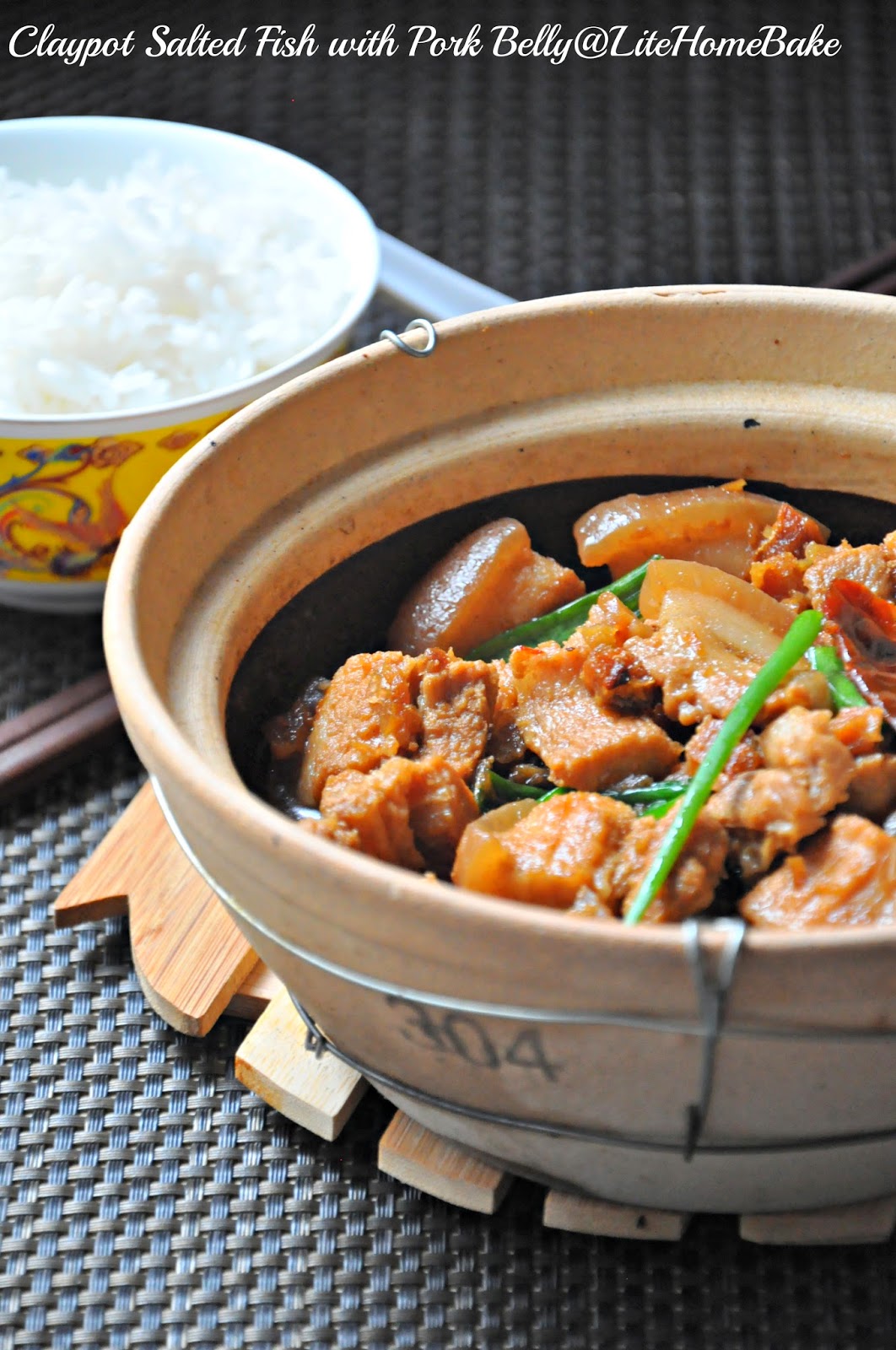
          This is a classic Chinese dish.  Let me guess,  the first thing that catches your attention would be those fatty layers and then the word sinful follows suit :)  Yes, guilty i am!  I know it's unhealthy but there's something about how meat and fat are nicely layered in pork bellies that make them irresistible!  And paired with salted fish which they say is also in the unhealthy category, they become the best partners in crime making this dish totally delicious, tempting and unforgettable!  To sin be it then...occasionally and repent after and the cycle goes on and on :))  If you are a Chinese like me, it gives you the more reason to make this,  we need to know how to make our classics, don't we?

          The flavors in this dish is intense resulting from the marriage of salted fish and soy sauce.  It is not something that appeals to everyone especially if you are not a fan of salted fish.  But for those of us who appreciate it, it is pure pleasure eaten with rice.  


          If you have extras, count yourself lucky since it tastes even better over time.  Over here, i have it served the traditional way with some porridge (with some sweet potatoes thrown in) and long beans omelette.  Simple yet  complete and very satisfying meal.

          My early attempts were made based on Amy Beh's recipe but i have since adapted it to suit our family's preference both ingredients and cooking method.

          Recipe

          Ingredients
          • 300g pork belly, sliced thinly
          • 50g boneless salted fish meat
          • 6 slices ginger
          • 1/2 of an onion, cut into wedges
          • 2 dried red chillies, cut into 2cm sections, seeded
          • 4 stalks spring onion, cut into 4cm lengths
          Seasoning (A)
          • 2 tbsp oyster sauce
          • 1 tsp sesame oil
          • 1 tsp sugar or to taste
          • 1 tsp pepper
          Seasoning (B)
          • 1 tbsp Hua Tiau wine
          • 250ml water 
          • 1 tbsp light soy sauce
          • 2 tbsp thick soy sauce
          Method
          1. Marinate the belly slices with seasoning (A). 
          2. Cut the salted fish into small little cubes.   Heat up 1 tablespoon of oil in a claypot then fry salted fish until crisp and fragrant. Set aside.
          3. Add another tablespoon of oil into the claypot.  Once heated add in ginger and onion.  
          4. Add in belly slices when ginger and onion start to smell fragrant.  Mix well.  Cover and cook for another 2-3 minutes until meat turns opaque.
          5. Add in soy sauce and dried chillies as in Seasoning B.  Mix well.  
          6. Add in water then cover the pot and let it come to a boil. Lower the flame and let it simmer until meat is soft. 
          7. Add in salted fish cubes and allow to simmer for another 2-3 minutes.
          8. Add spring onions and serve immediately from the pot!

          Saturday, 26 April 2014

          Hansik-Dwaeji Kalbi

          Koreans are popular for their kalbi/galbi dishes.  Kalbi literally means ribs but the term kalbi is also commonly used to refer to grilled beef ribs.  When it's Dwaeji Kalbi, it's grilled pork ribs as dwaeji means pig.

          I have chosen this recipe to try out as i hope to try out pork rib dishes from the selected countries alongside the Asian Food Fest blogging event.  The event is in its fifth country now and I have tried 2 so far, one from Thailand and Japan respectively and this is the third one.  I have missed out 2 where pork is not largely served as these are dominantly muslim countries.  Still, i am pretty sure there some dishes made with pork ribs by the non Muslims there, maybe, just maybe i will continue searching to complete the series.

          The spicy version was my choice from a recipe found here.  It's a treasure chest there, lots of authentic Korean recipes, do hop over to check it out.  I like that there are apples added into the marinade. The results were very good, finger licking i must say (yes it's better to eat them with your fingers)!  So, if you are planning a surprise treat for your loved ones or having guest for dinner over a weekend, why not consider making this, it's pretty easy to make and you can work on other dishes when these ribs hit the oven. Pretty sure your guest will be impressed!

          Doesn't it look good, looking at these pictures make me drool and want to make them again!

          Recipe
          Source: Korean Bapsang

          Ingredients
          • 5-7 pounds (2.25-3.18 kg) whole slab of baby back ribs (whole slab of pork ribs weighing around 2 kg)
          Marinade
          • 1/2 cup soy sauce (use 1/4 cup soy sauce for spicy version)
          • 2/3 cup water (replace with 2/3 cup gojuchang for spicy version - i used 1/2 cup)
          • 1/4 cup rice wine (or mirin)
          • 2 tablespoons sesame oil
          • 4 tablespoons honey
          • 3 tablespoons brown sugar (preferably dark brown)
          • 3 tablespoons minced garlic
          • 2 tablespoons grated ginger
          • 1/2 medium onion, grated
          • 1/2 medium sweet apple (Fuji, Gala, or Golden Delicious), grated
          • 1/2 teaspoon black pepper
          Method
          1. Prepare the ingredients for the marinade.  Mix all of the ingredients well.
          2. Cut each slab of the ribs into two pieces for easier handling. Rinse the ribs and drain. Coat the ribs well with the marinade, and marinate them for at least six hours (preferably overnight). Turn them over once after half of the marinating time has passed. (I got the butcher's help to do the cutting)
          3. Preheat the oven to 325°F (165°C).  Line a baking pan with aluminium foil. Arrange the ribs, meat side down, in a baking pan.  Cover the baking pan tightly with aluminium foil. Bake them for 1.5 hours. (you can bake them 30 additional minutes if you want fall off the bones tenderness).  Remove the foil cover.
          4. At this point, you can finish off the ribs by one of the following two steps:
            1. Change the oven setting to broil and preheat for a few minutes. Then broil the ribs for 4 - 6 minutes on each side, or until the ribs are slightly charred, and the sauce is caramelized. Baste the ribs with the sauce while broiling.
            2. Preheat the grill and grill the ribs over medium heat for 5 - 8 minutes on each side, or until the ribs are slightly charred and the sauce is caramelized. Baste the ribs with the sauce while grilling.
          Note:
          1. The ribs were tender enough for me after 1.5 hours
          2. For step no. 4, i chose option 1.
          As they say in Korean, Mashikeh-mogo (Bon Appetit)!

          Watching Korean dramas, have taught me a thing or two about their table etiquettes and dining language, thanks to the English subtitles :)  Now, i am not sure how real is this practised but I particularly like this pair:

          Before Eating:
          잘 먹겠습니다 - Jal moke get sum nida
          Literally this means “I will eat very well,” but it implies “Thank you for preparing the food. I appreciate you preparing this food.”

          After eating:      
          잘 먹었습니다 - Jal moke got sum nida (The “got” is pronounced more like “go” with a “t.”)
          Literally this means “I ate very well,” but again it implies “It was really good. Thank you so much for the food.”

          Sweet ain't it?  Makes all the toiling in the kitchen worthy!


          On a side note, let's keep the victims of the South Korean ferry tragedy, their loved ones and all those involved in the recovery mission in our prayers.  The sorrow of their loved ones are just beyond my imagination.  This year has not been too good huh, one big tragedy after another, sigh....

          I am submitting this post to Asian Food Fest: Korea, hosted by Sharon of Feats of Feasts

          Sunday, 6 April 2014

          Anytime is Coffee Time


          Did you miss your morning coffee?  Let's have it with some ribs over dinner :)  Weird? Somehow coffee and ribs does sound a little strange doesn't it?   They say it's a popular dish here and across the causeway.  I have read about it a couple of times but strangely i have not tasted it, i must have been going to the wrong places! Recently, i was reminded of this dish again when i saw it at Veronica's Kitchen.

          Apparently this is a dish where the ribs are deep fried then coated with a coffee sauce.    This cooking method where ribs are deep fried then coated with many different type of sauces are quite popular in Chinese restaurants.  Probably because the deep frying part can be done in advance making it something that can be done in a jiffy.  It only involves a simple stir frying and coating with the sauce for the final touch.

          It may sound simple but i never fancy doing the deep frying part for health reasons and the hassle of cleaning up after.  Health can't be a better excuse for laziness!  Instead of deep frying, i marinated the ribs with the sauce then pan fried them for some crisp bits (some cheat here to mimic deep fried ones) then braised it for awhile to make it tender. 

          Coffee flavor did come through, thankfully!  I used Nescafe Cap Columbie which has a fruity flavor.   There's slight bitterness coming from the coffee with a mix of sweet sourish taste and a little spiciness coming from the chilli sauce blended into the meat. Ahh, quite a mouthful trying to describe it, but it does taste quite special, something worth giving a go if you are a coffee lover :)

          Recipe
          Inspiration: Veronica's Kitchen

          Ingredients
          • 500g pork ribs
          Marinade
          • 1 1/2 tbsp oyster sauce
          • 1 tbsp light soy sauce
          • 1 tsp dark soy sauce
          • 1/2 tbsp sugar
          • 1/2 tsp pepper
          • 1 tbsp chilli sauce
          • 2 tbsp tomato sauce
          • 1 tbsp instant coffee powder with 1 tbsp hot water to dissolve coffee powder
          Thickening
          • 1 tbsp corn flour
          Garnish
          • Roasted sesame seeds
          • Cucumber slices and strawberry halves 

          Method
          1. Mix pork ribs with marinade ingredients and set aside for an hour.
          2. Heat a deep frying pan and add 1-2 tablespoons of vegetable oil. When the oil is hot, add the spareribs (without the marinade). Cook them over medium heat until all sides are brown.
          3. Pour in remaining marinade and add water until just enough to cover the ribs.  Stir to mix well.
          4. Simmer until ribs are fully cooked and tenderized.
          5. Remove about 1 tablespoon of the sauce and allow it to cool.
          6. Dissolve corn flour with the sauce that has been removed then pour it back into the pan to  thicken the sauce.
          7. Garnish with some sesame seeds and serve hot.  Strawberries make a pretty garnish and went well with the sauce too.
          Note:
          1. I cooked everything in a pressure cooker that came with a stir fry function.  I stir fried it then allow it to simmer for 15 minutes before pressurizing it for 10 minutes.
          2. The amount of coffee can be reduced according to preference and type of coffee used. 

          Thursday, 2 January 2014

          Mapo Phai Kuat


          Let me make a guess, if you have heard of Mapo Tofu, you must be thinking Mapo what?? after reading the title of this post...Yes, you heard me right, it's Mapo Phai Kuat not Mapo Tofu :)

          This is a simple twist of the popular Mapo Tofu dish done with soft bone pork ribs (aka Phai Kuat in Cantonese), the type which i like to use for steaming.   

          Ever since trying out the Japanese version of Mapo Tofu recipe that my friend Lena posted when the Asian Food Fest event was featuring Japan, i have fallen in love with the recipe! This Japanese version is slightly milder in terms of the fieriness of a typical Szechuan version and there's a hint of sweetness coming from the use of mirin.  This toned down version suits my son well, making it something everyone in the family can enjoy.  I have cooked it many times.  It's a simple dish, one that can be done in 15 minutes yet very tasty and goes very well with rice.  It taste really delicious especially when you scooped it directly on top of a bowl of piping hot rice as soon as it is ready and start indulging from there on!

          So, coming back to Mapo Phai Kuat...while still undecided on how to do my pork ribs,  this mapo tofu recipe came to mind.  And i thought, the mapo tofu sauce should make a great marinade for steaming too. And as they say, the rest is history, that plate of ribs turned out delicious!  I added some soft silken tofu to steam them together with the ribs too.  You won't get that maillard flavors that you will find in mapo tofu but you will get ribs that are just as tasty with the sauce infused into them.  Easy peasy, fast, healthy and tasty, can't ask for more!

          Recipe 
          Inspired byHer Frozen Wings with recipe from Just One Cookbook 

          Ingredients
          • 2 cloves of garlic, minced
          • 1 tbsp ginger, minced
          • 300 gms soft bone pork ribs
          • 1/2 package silken tofu, slice into medium size pieces
          • 2 stalks green onions, sliced
          Marinade 
          • 1 tbsp chilli bean paste ( doubanjiang with chilli)
          • 2 tbsp mirin
          • 1 tbsp miso
          • 1 tbsp oyster sauce
          • 1/2 tbsp soy sauce
          Thickening solution
          • 1tsp corn flour
          Steps
          1. Mix all the ingredients for the marinade in a bowl.
          2. Mix pork ribs with garlic, ginger and marinade.
          3. Set aside to marinade for 30 minutes.
          4. Before steaming, mix the ribs with a teaspoon of corn flour.
          5. Place ribs and tofu on a steaming dish.
          6. Steam over high heat for 20 minutes until pork ribs are cooked through.
          7. Sprinkle sliced spring onions on top of dish before serving hot.

          Friday, 8 November 2013

          Let's Cook Thai - Southern Style Pork Ribs

          Some of you might have noticed that I love pork ribs and most of the time i will choose to braise them, easy peasy.   I am lazy like that, easy preparation methods are always my way to go. Braising (if done well) results in very tender and succulent ribs, i love how the ribs end up with a taste that commingles with the braising liquid. Besides, it also provides a nice stew that goes very well with rice, our staple.   

          With Asian Food Fest (AFF) blogging event, i have been curious if people from the featured country like pork ribs and how they make (preferably braise) them.  I have been looking out for their recipes and have been successful thus far.  I have done the Japanese style for last month's AFF here and moving on to Thailand for this month.  Hopefully my interest won't die out and will continue along with the AFF journey.  Looking forward to a collection of Asian Pork Ribs recipes!

          The name of this dish is Gar Doog Mu Hung Le (Southern Thai Pork Ribs) which like in its name a typical Southern Thailand pork ribs dish.   Not much of a background on the dish?  That's about all i manage to find, my apologies if it is not enough to satisfy :)

          So, how did this taste?  In one word, delicious! Very flavorful, just a hint of spiciness (which probably  would have been a lot more if not because i had to tone it down to suit my son), very fragrant from the herbs and a lot of sweetness from the onions.   We loved it although i didn't follow the recipe to a T.  I guess we have to play by ear (a little not too much lest the original flavors disappear with the playing) when trying out recipes from a different culture, some tuning maybe in need to make it to more acceptable for our taste buds.

          Like i said earlier on, easy peasy, a 5 steps recipe!

          Recipe
          Reference: Appon's Thai Food

          Ingredients 1 
          • 60 gms Big Dried Red Chillies (1 tbsp prepared dried chili paste)
          • 60 gms Small Red Onion
          • 60 gms Garlic
          • 60 gms Lemon Grass
          • 60 gms Coriander Root (Roots from 2 plants)
          • 1 Teaspoon Salt
          Ingredients 2 
          • 600-800 gms Pork Ribs
          • 2 Tablespoon Fish Sauce
          • 400 ml Water
          • 4 Tablespoons Oil (omitted)
          • 4 Tablespoons Sugar (2 tbsp)
          Steps
          1. Chop all the ingredients from the first list, pound together to form a paste. (I used a blender)
          2. Mix into the second lot of ingredients and leave for 30 minutes. (100ml water of water and left it for 1 hour) 
          3. Put pork into a medium size pot.  Add in remaining water and stir to mix well. Water should be just enough to cover ribs.
          4. Bring the pork and sauce to boil, then turn down the heat and simmer for 1-2 hours. Add a little water if it dries out. (Ribs were tender within 1 hour)
          5. For best results, leave it overnight and recook it the following day. (Was good enough for us after 3 hours or so)
          Note: 
          1. The recipe above is doubled of the original recipe for my easy reference.  I normally make around 600-650g of pork ribs for 1 meal.
          2. My variations are noted in blue.  
          3. The biggest variation would be the amount of chili which i had to reduce to suit my son's accepted level of spiciness.  If  you have readily prepared chili paste on hand, it would be easier to control the spiciness by starting of with a smaller amount and increasing it to preference at a later stage.


          I leave you with some sights around the iconic floating markets of Thailand.  This particular one here is in Bangkok at the Taling Chan District and on the Khlong Chak Phra canal.  One that is much smaller, popular with the locals (i.e. less touristy), personally it is one that is good enough for me to sample a flavor of the floating market.

          Scenes along the canal taken during a long tail boat ride

          I am submitting this post to Asian Food Fest (Thailand) - November Month hosted by Lena of Frozen Wings

          Wednesday, 30 October 2013

          Japanese Style Braised Pork Ribs


          Most of the Japanese dishes that I have come across make use of the pork belly, a cut that i must agree makes the most delicious dishes.  But it is also one that i rarely buy mainly for health reasons, i have this weird notion of those glorious fats transferring from porky's belly to mine when i eat them!  So, I normally go for the ribs instead.

          This braised spare ribs recipe is from a book named The Japanese Kitchen by Hiroko Shimbo.  This dish is known as Supearibu no Nikomi in Japanese.  Supearibu does sound like spare ribs doesn't it? Well, it is!  And Nikomi means stew.

          I would describe the taste as something similar to Chinese style barbecued ribs with a tinge of spiciness and less sticky. We had it with rice for dinner but it would do well as a finger food served with some cold beer too.


          Recipe
          Source: The Japanese Kitchen by Hiroko Shimbo

          Ingredients
          • 1 1/2 pounds pork spareribs (400g)
          • 3 tablespoons shoyu (soy sauce) (1 1/2 tbsp)
          • 1 teaspoon Worcestershire sauce
          • 1/2 teaspoon toban jiang (chili-bean sauce)
          • 1 1/2 tablespoons honey (1 tbsp)
          • 2 tablespoons vegetable oil (1 tbsp)
          • 1/4 cup sake (rice wine)
          • 2 tablespoons sugar (1 tbsp sugar)
          • 3 tablespoons komezu (rice vinegar) (1 tbsp)
          • 1 teaspoon sesame oil
          Steps
          1. Cut the meat into individual ribs.
          2. In a bowl, combine 1 tablespoon of the shoyu, the Worcestershire sauce, the chili-bean sauce, and the honey. Marinate the spareribs in this mixture for 30 minutes. I left if for 1 hour.
          3. Remove the spareribs from the marinade, and discard it.
          4. Heat a medium skillet, and add the vegetable oil. When the oil is hot, add the spareribs. Cook them over medium heat until all sides are brown. Remove the spareribs from the skillet, and set them aside.
          5. Into a medium pot, put the spareribs, sake, sugar, and 1/2 cup water. Bring the mixture to a boil, and cook it over low heat, covered, for 20 minutes.
          6. Add the remaining 2 tablespoons shoyu and the komezu to the pot, and cook, uncovered, for 10 minutes, basting the spareribs several times with the cooking liquid. (I let it cook until the sauce was just enough to coat the ribs)
          Note: My variations in blue.

          And like they say in Japanese, Itadakimasu!

          I am submitting this post to Asian Food Fest # 1 Oct 2013 : Japan hosted by Alan from Travelling-Foodies 

          and this post is linked to the event, Little Thumbs Up organised by Doreen from My little Favourite DIY and Zoe of Bake for Happy Kids, hosted by Mich of Piece of Cake at this post
          Photobucket

          Friday, 27 September 2013

          Give me a Yeehaw!


          I have been wanting to participate in the Cook Like A Star blogging event but somehow it never happened until today despite the event going on for awhile already.  I find it a good introduction to dishes by quite a few celebrity chefs, some that i only got to know through this event :)

          It's Ree Drummond this month, and I managed to try out one dish this time.  Ree lives on a working ranch, it must be wonderful to cook and bake like her with the luxury of having the freshest ingredients.  She reminds me of tv drama series like Little House on the Prairie and Dallas evoking memories of times when the family will crowd around the tv waiting for a new episode every week.  Those were the days when we had only 3 channels to choose from and now we have God knows how many. I like her way of presenting each recipe, her step by step tutorial has large photos accompanying them (besides some humorous remarks) making it easy to follow and good for crosschecking if one is on the right track.

          I tried out what Ree named as BBQ Comfort Meatballs.   Comforting food for lunch on a lazy Sunday afternoon, couldn't be better.  Besides, oats was on the ingredients list, I couldn't miss this chance to sneak some into my men's diet (got you my men, cunning smile on mummy's face...) 

          The steps are easy except for the frying part, not difficult but not something i like doing or serving at home.  I made do with shallow frying.  These meatballs turned out delicious, soft and tender, meatloaf kind of texture and smelt really good.

          My son was quite skeptical about the initial pairing of the meatballs with some greens and crusty french bread toasted with butter.  "Just this? " the young man questioned.


          So, mummy went back to the kitchen and quickly made a second pairing for the starving young man who just got home from his Taekwando session.   And cowboy meal turned oriental with some instant egg noodles!  Those air dried type where all you need is to cook them al dente in some boiling water.  Toss them with a little shallot oil, a drizzle of soy sauce and a dash of salt and pepper.  Actually, Ree did suggest serving them with egg noodles tossed in melted butter as an option but i am not too sure if this is what she meant and the chinese in me gave the noodles an oriental drizzle instead.    Hmm, i wonder what will the cowboys say to this?  Funny, how i imagine them laughing until they fall off their chairs, err no, horses i mean :)  Jokes aside, i got a Yeehaw from my young man.  He happily polished it clean on top of adding another 2 meatballs to it.   Maybe, just maybe cowboys will give this pairing a Yeehaw too!


          Recipe
          Note : Notes in blue are for half the recipe (which i made) and my variations

          Ingredients

          For Meatballs
          • 1-1/2 pound Ground Beef (350g minced pork)
          • 3/4 cups Oats (1/3 cup)
          • 1 cup Milk (1/2 cup)
          • 3 Tablespoons Very Finely Minced Onion (2 tbsp from 1 big onion)
          • 1-1/2 teaspoon Salt (1/2 tsp)
          •  Plenty Of Ground Black Pepper, to taste
           For Cooking Meatballs
          • 1 cup All-Purpose Flour (coating For Frozen Meatballs)-(1/2 cup)
          •  Canola Oil
           For Sauce
          • 1 cup Ketchup (1/2 cup)
          • 2 Tablespoons Sugar (1 tbsp)
          • 3 Tablespoons Vinegar (1 tbsp)
          • 2 Tablespoons Worcestershire (1 tsbp)
          • 4 Tablespoons (to 6 Tablespoons) Onion (remainder from onion left after adding to meatballs)
          • 1 dash Tabasco (1 tbsp chilli sauce)
          Steps
          1. Preheat oven to 350 degrees (190C).
          2. Combine all meatball ingredients. Roll into medium-small balls and place on a cookie sheet. Place sheet in freezer for five minutes.
          3. After 5 minutes, remove meatballs from freezer and immediately dredge in unseasoned flour.
          4. Brown meatballs in canola oil until just brown. Place into a baking dish.
          5. Combine all sauce ingredients. Pour over meatballs and bake at 350 degrees (190C) for 45 minutes. Serve with egg noodles, mashed potatoes, or crusty French bread.

          Photobucket

          I'm linking this post to Cook Like a Star, an event co-hosted by Zoe of Bake for Happy KidsBaby Sumo of Eat Your Heart Out and Mich of Piece of Cake

          Thursday, 11 July 2013

          Not One But Three

          Love curries? If you do, there are three to choose from in this post :)  I was looking at my backlog and started scratching my head (while sighing).  So, i decided to clear all three curry dishes in my backlog in this one post.  And having three to pick from is better than one if you are looking for a curry to make, surely.

          Curries are popular dishes in the Asian part of the world.  It has become a dish that is very varied with the different cooking styles though underlying it is still meat/vegetables cooked in a rich concoction of spices.  My family love curries, everyone will be eagerly waiting for meal time once they catch a whiff   of it.  

          In this post you will see that each of these curries have their own main ingredient lending each variation a distinctive taste of its own.

          First up is this Vietnamese style spicy lemongrass chicken.  This was quite popular among bloggers some time back and I have made it a couple of times since then.  As in the name, the key ingredient for this one is the lemongrass which gives it a nice, lemony fragrance.  The use of fish sauce and palm sugar gave the curry a light savory sweet umami flavor.    

          I did not follow the original to the T, mainly to make it more convenient for me.


          Recipe-Vietnamese Spicy Lemongrass Chicken
          Source : First spotted on Nasi Lemak Lover with original recipe from Echo's Kitchen

          Ingredients

          Spicy lemongrass paste
          • 5 Fresh Lemongrass(use only the white part)
          • 25 Dried Red Chilireplaced with 5 tbsp grounded chili paste)
          • 1 1/2 inch of ginger root 
          • 8 Cloves of garlic
          Method
          1. Slice the lemongrass and ground it together with all other ingredients into a paste.  
          2. It is OK if the paste is a little coarse
          Spicy Lemongrass chicken
          • 1/3 cup cooking oil
          • 3 tbsp Spicy Lemongrass Paste
          • 500g chicken pieces/chicken breast pieces(marinate with a pinch of black pepper powder and some salt)
          • 1 tsp Meat Curry powder (1 tsbp)
          • 1/2 onion, chopped ( 1 big onion)
          • 1 tbsp Soy sauce/Fish Sauce 
          • 1/2 tsp Salt (1 tsp) 
          • 1/2 tsp Sugar/Palm Sugar (shaved palm sugar to taste)
          Method
          1. Heat up oil in pan then fry lemongrass paste until fragant and slightly dry.
          2. Remove the additional paste leaving 3 tbsp of paste in the pan.
          3. Add in chicken and fry to coat with spices.
          4. When grease released from the chicken is visible, stir in the chopped onion, and cook for another minute until onion soften, add in curry powder and stir well until it smells fragrant.
          5. Add about 1/2 cup of water, salt, soy sauce/fish sauce and sugar.
          6. Bring it to boil then simmer until chicken is cooked and until gravy is reduced to preferred thickness.


          This other curry is the Green Curry which is a popular Thai cuisine.   It obviously got its name from its colour, and its color from green chillies and coriander.  Don't be deceive by the color though, it can be as fiery as its redder cousins. The aroma can be quite strong and may not be well received especially for those who dislike coriander.  If so, the amount of coriander used can be slightly lessen.

          This is my first time making green curry, thought I would give it a try after drooling at the one blogger friends,  Kimmy and Phong Hong posted.


          Recipe-Thai Green Curry

          Ingredients for Paste 
          (A)
          • 3 lemon grass (white part only)
          • 1 inch piece ginger
          • 1 tsp black peppercorns 
          • 4 large green chillies
          • 10 small Thai green chillies
          • 4-5 cloves garlic
          • 10-12 shallots
          • 2 tsp grated kaffir lime zest
          • 2-3 stalks fresh coriander with roots
          (B) 
          • 1 tsp salt
          • 2 tsp coriander powder
          • 1 tsp cumin powder
          • 1 tsp tumeric powder
          • 2 tsp fish sauce
          • 1 tbsp oil
          (C)
          • 800 gm chicken thighs - cut bite size pieces
          • 1-2 stalks basil leaves - used the leaves only
          • 5-6 kaffir lime leaves - shredded finely
          • 150 ml water
          • 100 ml coconut milk
          • 2 medium size eggplants (cut into half then slice to 3 inch long pieces)
          • 3-4 tbsp oil
          • 1/2 tbsp salt
          • 1 tsp sugar to taste

          Method
          1. Blend ingredients A in a blender until fine.
          2. Mix with rest of ingredients B into a paste.
          3. Fry paste with about 100 ml oil until oil separates then remove additional paste to store if amount of meat is lesser than amount noted.
          4. Add in chicken pieces and mix well.  Add in water after meat turns opaque.
          5. Bring to a boil then add in eggplants.  Simmer until chicken is tender.  Add in coconut milk.  Cook until gravy is slightly thick.  Add seasoning to taste.
          6. Stir in the basil leaves and kaffir leaves if serving immediately otherwise add the leaves when reheating the curry before serving.

          And the last one here (but not the least definitely) has an Indian origin, specifically a town named Goa in Southern India.   This type of curry is known as the Vindaloo.   And it's also interesting to know that  the Vindaloo originated from a Portuguese dish known as Carne de Vinha d' Alhos,  which is a meat dish (normally pork) cooked with wine vinegar(vinha) and garlic(ahlo).  The Indians then added their signature touch to it with fiery spices after the Portuguese explorers introduced it to them when they arrived  at Indian shores way back in the 15th century.

          I am not sure how authentic this recipe is, it was from a recipe booklet that came free with a tub of yogurt.  The original recipe called for chicken but i used pork ribs instead.  As the norm with complimentary recipes, one of the ingredient has to be the one from the sponsor.  Yogurt was used to marinate the meat.   It's quite an easy recipe as it suggested use of instant curry paste.  This was the first time i tried this recipe and we loved it.  The use of yogurt instead of coconut cream made it less guilty but just as flavorful.  The addition of some tomato sauce gave a slight sweetness to it too.
              

          Recipe-Pork Vindaloo
          Source : Nestle Yogurt Recipes Collection

          Ingredients
          • 500g pork ribs/chicken pieces
          (A)
          • 6 tbsp set yogurt
          • 1 tbsp lemon juice
          • 1 tbsp pounded garlic
          • 1 tbsp pounded ginger
          • 1 tsp grounded black pepper
          (B)
          • 1 sachet curry chicken paste (1/3 packet of Tean's Gourmet Chicken Curry Paste)
          • 1 onion diced
          • 2 sprig of curry leaves
          • 1 tomato diced
          • 1 tsbp tomato ketchup
          • 3/4 cup water
          • 1 stalk coriander leaves
          Method


          1. Marinade meat with ingredients from Part A for several hours  (I only had time to marinate it for 1 hour).
          2. Heat oil and fry onion until soft and fragrant.
          3. Add curry leaves, tomato and curry paste.  Fry until aromatic.
          4. Add in marinated meat and mix well.  Add tomato ketchup and water after meat turns opaque.
          5. Simmer until gravy is slightly thick and meat is cooked and tender.  (I let it simmer for 15 minutes before transferring it to the pressure cooker for 5 minutes to have a nice melt in your mouth ribs)
          6. Season with salt and pepper.
          7. Garnish with coriander leaves.


          Share

          Twitter Delicious Facebook Digg Stumbleupon Favorites More