Advertisement 300 X 250

Girls' Best Friend

Bright and sparkly. Gemstones came to my mind when I was removing this Dragon Fruit and Orange jelly from the mould. Like a combination of gemstones...rubies, amber and diamonds, all in one!

Dragon's Eyes

The literal translation for the name of a small brown, juicy exotic fruit from the lands of Asia, known as Longan in Chinese, packed into these muffins

Nostalgia

A taste from the humble beginnings, the Long Bean Rice brings back beautiful memories of the yesteryears

Light and Fluffy

Lemon, Yogurt and Cranberries~a nice blend of flavours in a light and fluffy chiffon cake

Bread Stories

Asian style buns ~ Popular as breakfast food or snack, sweet/savoury fillings wrapped in soft, cottony bread

Thursday, 22 May 2014

Classically Sinful!


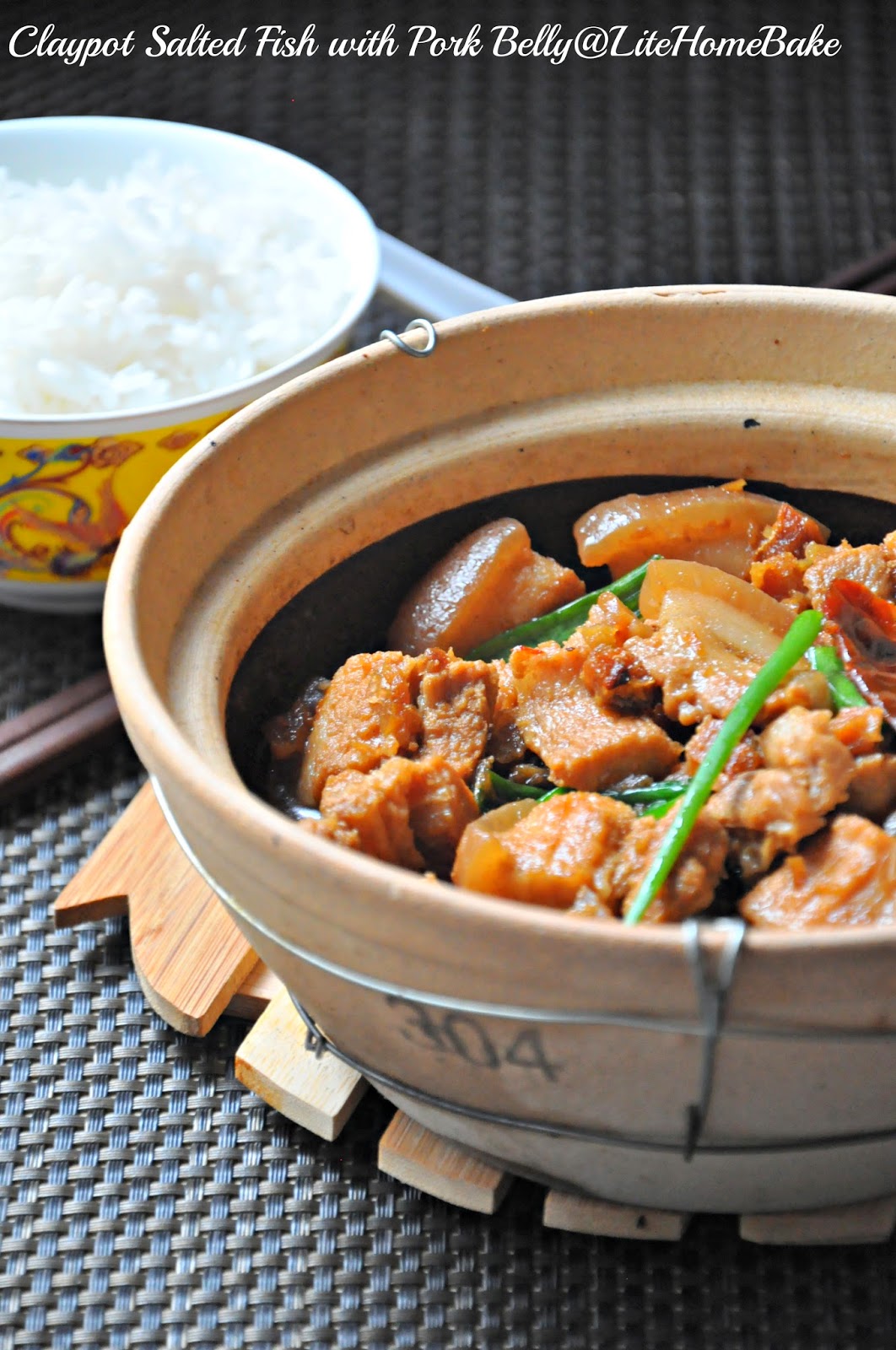
This is a classic Chinese dish.  Let me guess,  the first thing that catches your attention would be those fatty layers and then the word sinful follows suit :)  Yes, guilty i am!  I know it's unhealthy but there's something about how meat and fat are nicely layered in pork bellies that make them irresistible!  And paired with salted fish which they say is also in the unhealthy category, they become the best partners in crime making this dish totally delicious, tempting and unforgettable!  To sin be it then...occasionally and repent after and the cycle goes on and on :))  If you are a Chinese like me, it gives you the more reason to make this,  we need to know how to make our classics, don't we?

The flavors in this dish is intense resulting from the marriage of salted fish and soy sauce.  It is not something that appeals to everyone especially if you are not a fan of salted fish.  But for those of us who appreciate it, it is pure pleasure eaten with rice.  


If you have extras, count yourself lucky since it tastes even better over time.  Over here, i have it served the traditional way with some porridge (with some sweet potatoes thrown in) and long beans omelette.  Simple yet  complete and very satisfying meal.

My early attempts were made based on Amy Beh's recipe but i have since adapted it to suit our family's preference both ingredients and cooking method.

Recipe

Ingredients
  • 300g pork belly, sliced thinly
  • 50g boneless salted fish meat
  • 6 slices ginger
  • 1/2 of an onion, cut into wedges
  • 2 dried red chillies, cut into 2cm sections, seeded
  • 4 stalks spring onion, cut into 4cm lengths
Seasoning (A)
  • 2 tbsp oyster sauce
  • 1 tsp sesame oil
  • 1 tsp sugar or to taste
  • 1 tsp pepper
Seasoning (B)
  • 1 tbsp Hua Tiau wine
  • 250ml water 
  • 1 tbsp light soy sauce
  • 2 tbsp thick soy sauce
Method
  1. Marinate the belly slices with seasoning (A). 
  2. Cut the salted fish into small little cubes.   Heat up 1 tablespoon of oil in a claypot then fry salted fish until crisp and fragrant. Set aside.
  3. Add another tablespoon of oil into the claypot.  Once heated add in ginger and onion.  
  4. Add in belly slices when ginger and onion start to smell fragrant.  Mix well.  Cover and cook for another 2-3 minutes until meat turns opaque.
  5. Add in soy sauce and dried chillies as in Seasoning B.  Mix well.  
  6. Add in water then cover the pot and let it come to a boil. Lower the flame and let it simmer until meat is soft. 
  7. Add in salted fish cubes and allow to simmer for another 2-3 minutes.
  8. Add spring onions and serve immediately from the pot!

Monday, 19 May 2014

Plain Basics from Who's Who

This is a big name! Wu Pao Chun is not only a famous baker in Taiwan but he made waves internationally when he clinched the title of Master Baker in the bread category of the 2010 Bakery Masters competition (Les Masters de la Boulangerie)  held in Paris. It is said that people throng his bakery everyday to buy his award winning Millet Wine, Rose Petal and Dried Lychee Bread, quite a mouthful, huh.  I have not had the opportunity to try any of his bakes though.

This is not his award winning bread (can't expect him to share it, can we?) but another known as Champion Toast.  I first saw it at Victoria's blog, who credited Aunty Young who adapted from ccm2poco where the recipe was first shared.  Thank you, ladies! Although i may not know how close this is to the real mccoy this recipe is a keeper for sandwich bread.  It is a simple recipe with just a few ingredients but the result is satisfying.  The bread that it produces is really soft and it stays soft for 3 days.  The other good thing is the fat content is low, only 15g.

Cottony soft bread

Some other ways to enjoy the bread...


Make a Nutella banana sandwich. Spread some nutella on a slice of bread, top it with some banana slices then cover it with another slice of bread.  Toast it in the oven for 3 minutes and you will have warm crisp bread, slightly runny Nutella and soft bananas in between!


Does this bring back old memories for you?  I remember eating more of this when i was a kid.  I had my late grandma in my thoughts when i made this, she loved toast made this way.  Spread on some butter, sprinkle some sugar and toast it until it's all hard and crunchy!  

Recipe
Reference: Victoria Bakes /Aunty Young/ccm2poco

Ingredients
  • 300g bread flour
  • 24g sugar 
  • 1 tsp salt
  • 15g unsalted butter
  • 3/4 tsp instant dry yeast
  • 198g milk
Steps
  1. Mix all ingredients (except butter) into a dough using low speed, then use medium speed to knead it into a shiny and smooth texture.
  2. Add in the unsalted butter, then knead it using medium speed until it forms dough that can be stretched into a thin, translucent membrane.
  3. Proof the dough for about 60 minutes. (Until about double the size)
  4. Divide dough into 3 equal balls, then allow to rest for another 10 minutes. (Skipped)
  5. Flatten the dough into a rectangle shape and roll it up . Rest it for 10 minutes
  6. Repeat step no. 5 to the rolled up dough, then place it on the baking tray and go for final proofing for another 50 minutes. (I used a Pullman tin for a 450g loaf and put it to bake when it was 90% full .  I baked it uncovered)
  7. Bake in a preheated oven at 190°C for 30 – 35 minutes
Note:  I combine all the ingredients and let my breadmaker handle steps 1 and 2 using the Dough programme. 

This post is linked to the event, Little Thumbs Up organised by Zoe of Bake for Happy Kids and Doreen from My little favourite DIY, hosted by Tze of Awayofmind Bakery House.

Photobucket

Tuesday, 6 May 2014

It's Magic!

If you have not tried Shio Koji, trust me, you have got to go look for it!   I have read that some of the Japanese people call this their magical seasoning and i tell you i can't agree more!  It is really, really delicious and the best part is it's so versatile and simple to use!   All you need is basically this one seasoning and it will bring out the best flavors in both meat and vegetables whether you braised, fry, steam or even just as a seasoning for salad or pickle!      

I have Nami of Just One Cookbook to thank for introducing me to this magical ingredient.  I got to know about it when she posted this dish on her blog.  It came at the right time as I was about to go for a holiday in Japan.  I made a mental note to look for it when i get there.  Initially, I tried looking for it on my own when i got to a supermarket but i gave up after some time and got some help instead as most of the stuff does not have any English labelling on them.  I went to a wrong section, i thought it was probably on the aisle where all the sauces are since the one I saw at Nami's was in a sauce bottle but the young man brought me all the way to where it was and pointed it out to me. Service in Japan is just ichiban!  It's at the refrigerated area, btw :)

So, what is shio koji?  Koji is essentially rice that's been inoculated with the koji mold.  When it is combined with water and salt and allowed to ferment it turns to shio koji where shio means salt.  In appearance, it looks like rice porridge with some rice grains still visible though i have read that it can also look like a puree.  Koji is also the ingredient used for making soy sauce, sake and miso in Japan.

Coming back to this dish, this is my third time making it already and there goes all the shio koji that i brought back from Japan.  I went hunting for more in our local Isetan supermarket and was very happy to find it available, so fellow Malaysians you know where to get it if you are interested to try :)  It's at the section where they place sashimi.  They also have salmon that has been pre-marinated with shio koji for sale.  That's the pack that i got from Isetan KL.

This is a no fuss dish, so simple yet one gets blown away by the flavors!  Some sweetness mixed with a savory depth that has a miso-like aroma.  The chicken is marinated with shio koji then pan fried for awhile to give it some browning before adding in some root vegetables and lastly braised with some wine until chicken is tender.  Shio koji has a tenderizing effect on the meat too.

I have my own twist to this recipe now that i have made it a couple of times. The addition of Japanese sweet potatoes makes the dish sweeter and vice versa the potatoes taste really good with the umami flavors of shio koji blending into them.  I have also added in some mini king oyster mushrooms that never seems to be enough for us :)

Besides this dish, i have used shio koji as a marinade for fish before steaming or panfrying it.  I have read that the rule of thumb on the amount of shio koji to be used is 10% of the weight of food to be marinated and finds that it suits our family's taste buds.

The only downside to shio koji is it's expensive in Malaysia.  A small pack of 200g cost me RM16.90 (around USD5).  There are guides out there on how to make your own though.  An important point to remember is shio koji burns easily.  Do make sure you use low-medium flame if you are  pan frying fish/meat that is marinated with just shio koji, and yes i burnt my way to learned this :)  And like most other marinade, the longer it is left to marinate, the better it taste.

I am going to stop waxing lyrical about it, you have got to try it yourself but i admit i am a little crazy about it :)

Recipe
Reference: Just One Cookbook

Ingredients
  • 4 (about 1 lb) bone-in, skin-on chicken thighs, rinsed and pat dry (2 chicken thighs)
  • 2 tbsp Shio Koji
  • 2 cloves garlic, minced/crushed
  • 1 tbsp all-purpose flour (omitted)
  • 1 tsp paprika (omitted)
  • 1/2 tsp dried rosemary (2 sprigs rosemary)
  • 1/2 tsp dried oregano (1 tbsp fresh oregano)
  • 1 tbsp olive oil
  • 1 thin carrot, cut into 2 inch thick slices
  • 1/2 large onion, cut into 4 wedges
  • 1 cup chicken broth (400ml water)
  • 1/4 cup dry white wine (1/4 cup sake)
  • 1 small red potato (1 small russet potato)
  • 1 medium size Japanese sweet potato)
  • 150g mini king oyster mushrooms (cut the bigger ones into half otherwise leave it whole)
  • 1 tablespoon corn flour
Method
  1. Put the chicken, shio koji, and garlic in a large plastic bag and massage ingredients together. Marinate in the bag for 30 minutes. (Left to marinate for 2 hours in the fridge)
  2. Add flour, paprika and herbs to the bag and shake to coat. 
  3. Heat oil in a Dutch oven over medium heat. Place chicken (skin side down) and remaining marinade into the Dutch oven. (I used a pressure cooker with stir fry function but a deep pot would work find too)
  4. Cook 3 minutes on each side or until lightly brown.
  5. Add carrot and onion and cook for 2-3 minutes, stirring constantly.
  6. Add broth, wine, and potatoes and bring to a boil.
  7. Reduce heat and simmer covered for 40 minutes or until chicken is done and vegetables are tender. (Simmered for 15 minutes, then changed to high pressure function for 7 minutes).
  8. If mushrooms are used, add them in about 10 minutes before turning off the flame or if cooking in high pressure, add them in just before setting on high pressure.
  9. If you like a thicker sauce, remove about 2 tablespoons of the sauce and allow it to cool.
  10. Dissolve corn flour with the sauce that has been removed then pour it back into the pan and allow it to come to a boil again to  thicken the sauce.
  11. Garnish with freshly ground black pepper before serving.

Friday, 2 May 2014

I Not Stupid, Mum!


Lotus root soup is very popular among the Chinese.  We believe it is nourishing and has a cooling effect.  A typical version is made with either pork ribs/chicken, peanuts and red dates, a pretty simple concoction but results in an amazing taste.  Among other variations that are just as delicious are those with the addition of root vegetables like carrots or kudzu root and legumes like black beans. 

I had lotus root in my fridge the other day but i had ran out of both pork ribs/free range chicken so i thought it would be a good excuse to make a vegetarian version :)  And i had something mischievous up my sleeve, i wanted to test if this meatless version would go by unnoticed by the men in my house who are meat lovers. Wondering how something so obvious would go by unnoticed?  Surely the eyes would tell, you must be thinking but most of the time they would only drink the soup without eating any of the ingredients so I actually put very little of the ingredients in their  soup bowls. Hence, it would be more of a taste test rather than a sight test in this case.  I know chances are slim that it will go unnoticed but no harm trying and if it does or even if they like the taste of it could be the start to more meatless soups!

I decided to use a recipe from Amy Beh, a celebrity chef who is also a columnist who shares her recipes in one of our local dailies as a reference.  Bean sticks were used as a substitute for meat protein.  The Chinese herbs called for were very much similar to those used in a meat version but the addition of ginger and dried lily buds gave a slightly different flavor to the soup.   Unlike in a typical version there were no peanuts in this one but i added a few walnuts to give it some nutty flavor and oil since walnuts are rich in Omega-3 fatty acids.

Overall i find myself enjoying the soup but i must admit that i am a soup lady, i love almost any soup!  The soup was very clear and had a refreshing taste with some heat coming from the ginger. There was quite some bite too with the addition of bean sticks and lily buds.  

So, did it go by unnoticed? The answer is 'No', unfortunately :(  My young man thought it tasted funny and wasn't as tasty.  I presumed the 'funny' taste that he was referring to came  from the bean sticks, ginger and lily buds while not as 'tasty' meant it didn't have the heavy taste from meat proteins.  Experiment failed!  Mum got busted..."I am not stupid, Mum!"


Recipe
Reference: Kuali.com

Ingredients

(A)
  • 100g lotus root, skinned and cut into thick strips (300g)
  • 25g yuk chuk, rinsed and soaked (replaced with 2 tbsp goji berry)
  • 10 red dates
  • 5g dong gwai (replaced with a 5 thin slices of American ginseng)
  • 6 walnuts
  • 2 pieces dried beancurd sticks, soaked till soft and cut into 4cm pieces (3 pieces)
(B)
  • 10g ginger, shredded (3 thin slices from 1 inch knob)
  • 15g dried lily buds, knotted, rinsed and soaked
  • 2 litres water (3 litres)
Seasoning
  • 1 tsp salt
  • 1/4 tsp pepper
  • 1 tsp vegetarian seasoning powder (omitted)
  • 1/8 tsp sugar or to taste (omitted)
  • 1/2 tsp sesame oil (omitted)


Method
  1. Combine ingredients (A) and water in a deep pot.  Bring to a boil.  Reduce the heat and simmer for 15-20 minutes. (40 minutes)
  2. Add ingredients (B) and boil for 5-6 minutes (10 minutes). Season to taste. Dish out and serve the soup hot.


Saturday, 26 April 2014

Hansik-Dwaeji Kalbi

Koreans are popular for their kalbi/galbi dishes.  Kalbi literally means ribs but the term kalbi is also commonly used to refer to grilled beef ribs.  When it's Dwaeji Kalbi, it's grilled pork ribs as dwaeji means pig.

I have chosen this recipe to try out as i hope to try out pork rib dishes from the selected countries alongside the Asian Food Fest blogging event.  The event is in its fifth country now and I have tried 2 so far, one from Thailand and Japan respectively and this is the third one.  I have missed out 2 where pork is not largely served as these are dominantly muslim countries.  Still, i am pretty sure there some dishes made with pork ribs by the non Muslims there, maybe, just maybe i will continue searching to complete the series.

The spicy version was my choice from a recipe found here.  It's a treasure chest there, lots of authentic Korean recipes, do hop over to check it out.  I like that there are apples added into the marinade. The results were very good, finger licking i must say (yes it's better to eat them with your fingers)!  So, if you are planning a surprise treat for your loved ones or having guest for dinner over a weekend, why not consider making this, it's pretty easy to make and you can work on other dishes when these ribs hit the oven. Pretty sure your guest will be impressed!

Doesn't it look good, looking at these pictures make me drool and want to make them again!

Recipe
Source: Korean Bapsang

Ingredients
  • 5-7 pounds (2.25-3.18 kg) whole slab of baby back ribs (whole slab of pork ribs weighing around 2 kg)
Marinade
  • 1/2 cup soy sauce (use 1/4 cup soy sauce for spicy version)
  • 2/3 cup water (replace with 2/3 cup gojuchang for spicy version - i used 1/2 cup)
  • 1/4 cup rice wine (or mirin)
  • 2 tablespoons sesame oil
  • 4 tablespoons honey
  • 3 tablespoons brown sugar (preferably dark brown)
  • 3 tablespoons minced garlic
  • 2 tablespoons grated ginger
  • 1/2 medium onion, grated
  • 1/2 medium sweet apple (Fuji, Gala, or Golden Delicious), grated
  • 1/2 teaspoon black pepper
Method
  1. Prepare the ingredients for the marinade.  Mix all of the ingredients well.
  2. Cut each slab of the ribs into two pieces for easier handling. Rinse the ribs and drain. Coat the ribs well with the marinade, and marinate them for at least six hours (preferably overnight). Turn them over once after half of the marinating time has passed. (I got the butcher's help to do the cutting)
  3. Preheat the oven to 325°F (165°C).  Line a baking pan with aluminium foil. Arrange the ribs, meat side down, in a baking pan.  Cover the baking pan tightly with aluminium foil. Bake them for 1.5 hours. (you can bake them 30 additional minutes if you want fall off the bones tenderness).  Remove the foil cover.
  4. At this point, you can finish off the ribs by one of the following two steps:
    1. Change the oven setting to broil and preheat for a few minutes. Then broil the ribs for 4 - 6 minutes on each side, or until the ribs are slightly charred, and the sauce is caramelized. Baste the ribs with the sauce while broiling.
    2. Preheat the grill and grill the ribs over medium heat for 5 - 8 minutes on each side, or until the ribs are slightly charred and the sauce is caramelized. Baste the ribs with the sauce while grilling.
Note:
  1. The ribs were tender enough for me after 1.5 hours
  2. For step no. 4, i chose option 1.
As they say in Korean, Mashikeh-mogo (Bon Appetit)!

Watching Korean dramas, have taught me a thing or two about their table etiquettes and dining language, thanks to the English subtitles :)  Now, i am not sure how real is this practised but I particularly like this pair:

Before Eating:
잘 먹겠습니다 - Jal moke get sum nida
Literally this means “I will eat very well,” but it implies “Thank you for preparing the food. I appreciate you preparing this food.”

After eating:      
잘 먹었습니다 - Jal moke got sum nida (The “got” is pronounced more like “go” with a “t.”)
Literally this means “I ate very well,” but again it implies “It was really good. Thank you so much for the food.”

Sweet ain't it?  Makes all the toiling in the kitchen worthy!


On a side note, let's keep the victims of the South Korean ferry tragedy, their loved ones and all those involved in the recovery mission in our prayers.  The sorrow of their loved ones are just beyond my imagination.  This year has not been too good huh, one big tragedy after another, sigh....

I am submitting this post to Asian Food Fest: Korea, hosted by Sharon of Feats of Feasts

Wednesday, 23 April 2014

Brain Food, It Is??

A long time ago, my mum asked this colleague of hers who was an excellent Maths teacher the secrets of him being so brainy and that teacher revealed to her that his mum fed him with a lot of fish when he was young, actually he even specified that it was thread fin, probably salmon wasn't popular back then since they are imported! And yes from then on we saw a lot of fish in our diet!

What's your take, is fish brain food?  Some say yes and some say no.  But many researches have found that the high content of Omega-3 fatty acids in Salmons is good for the brain.  It helps the brain works better and improves memory besides protecting the nervous system from the deteriorating effects of aging.   Talking about the benefits of fish in our diet reminds me of the famous quote from Bruce the shark in Finding Nemo,  he said "Fish are friends, not food"... err i have to say sorry but i am stuck with what Mum drummed into my head :)

So, Salmon aka brain food was on the menu for lunch the other day and i wanted to try out a new way of making it.  Well, not totally new as i intended to bake it like always, probably just a new glaze/sauce.  I was wondering if there were any recipes out there for something orangey, a quick search found me landing on plenty! 

 
It was basically 3 main ingredients, honey, orange juice and soy sauce with minced garlic and ginger to rid some fishy smell.  It gave the fish a sweet and citrusy flavor which my son enjoyed very much but hubs and i decided we prefer the good old savory taste better (i.e. just olive oil, a little lemon juice plus salt and pepper).


Served it with jasmine rice, some grilled french beans and stir fried baby king oyster mushrooms.  A simple, healthy and wholesome meal :)

Recipe
Source: My Recipes

Ingredients
  • 1/3 cup orange juice
  • 1/3 cup honey
  • 1/4 cup lite soy sauce
  • 1 tablespoon minced garlic
  • 1 tablespoon minced fresh ginger
  • 4 (4-ounce) salmon fillets (2 salmon fillets around 14 ounce)
  • 1/4 cup sliced green onions
Method
  1. Preheat oven to 375°F (190°C).
  2. Cook orange juice and next 4 ingredients in a small saucepan over medium heat, stirring occasionally, 1 minute; let cool slightly.
  3. Reserve 2/3 cup marinade; transfer remaining marinade to a large shallow dish or zip-top plastic freezer bag; add salmon. Cover or seal, and chill 15 minutes. Remove salmon from marinade, discarding marinade. Place salmon in an aluminum foil-lined pan.
  4. Bake at 375°F ((190°C) for 20 minutes or to desired degree of doneness.
  5. Meanwhile, cook reserved marinade in a small saucepan over medium heat 5 minutes or until sauce is thick and syrupy.
  6. Drizzle salmon with sauce, and sprinkle with green onions and sesame seeds.
This post is linked to the event, Little Thumbs Up organised by and Zoe of Bake for Happy Kids and Doreen from My little favourite DIY, hosted by Ann of Anncoo Journal.

Photobucket

Friday, 18 April 2014

Oriental Easter Bunny

As Good Friday begins may,
Mercy, Peace and Love be yours in Abundance ~ Jude 1:2

Bunny shaped steamed buns (or Pao in Chinese) to give it an oriental Easter mood.  It doesn't look exactly like a bunny since the ears are a bit pointy, unfortunately :(


I have made these soft and fluffy steamed buns quite a few times already with this recipe from Wendy.   You can leave them empty but i chose to fill them with some peanut butter that i needed to finish off asap.  With medium high heat, you could get some flowy peanut butter in the buns but if it's too high or re-steamed it tends to dry out.  If you leave it empty you could even eat it with some savoury dishes.

I substituted shortening with oil this time around and based on the results i think it actually taste better with shortening.

Happy Easter!


Recipe 
Source : Table for 2 or more... (this is 1/2 the portion which gave me 16 buns of around 40g each)

Ingredients
  • 250gm pau flour (cake flour)
  • 125gm steamed orange sweet potato
  • 50gm sugar
  • 1/2 Tbsp double action baking powder
  • 1/4 tsp salt
  • 20gm shortening, melted (30ml vegetable oil)
  • 6gm yeast 
  • 1/4 tsp sugar
  • 75ml water (start with 75ml, it depends on how moist the sweet potatoes are, mine needed 100ml water)
Method
  1. Proof yeast with 1/4 tsp sugar and water until it froths.
  2. Mix flour, baking powder, sugar and salt together. 
  3. Knead in steamed sweet potatoes. 
  4. Flour mixture will look crumbly. 
  5. Pour in frothy yeast mixture and combine to form a dough. Knead until dough no longer sticky and turns smooth. 
  6. Add more flour if it's too sticky or more water(by the teaspoon) if it's way too dry, (if unable to gather all the flour into a dough).  
  7. When dough is smooth, knead in melted shortening, until dough no longer feels oily.
  8. Leave to proof until double, about an hour.
  9. Punch down and knead for another minute. Divide dough into 40gm pieces, and shape as preferred.   
  10. Leave to proof until shaped bun doubles. 
  11. Steam on high heat for 12-15 minutes. (10 minutes)
Notes
  1. If like me, you are using a machine to knead, skip steps 1-7 but follow through step 6.  I used my breadmaker to knead the dough, I put everything in the recommended order, i.e. liquid (water, melted shortening), sugar, salt, followed by flour (sifted and mix with baking powder), mashed sweet potato and lastly yeast.  
  2. To make bunnies, form dough into oval shape.  Flatten with a rolling pin then add in 1 tsp of filling if using.  Pinch and seal well.  Just before putting them to steam, use a pair of kitchen shears to make a cut for the ears.  Use a toothpick dipped with some red food gel to make 2 dots for the eyes. 

Share

Twitter Delicious Facebook Digg Stumbleupon Favorites More